Balcony Nets or Invisible Grills in Bangalore? Choose Around the Problem
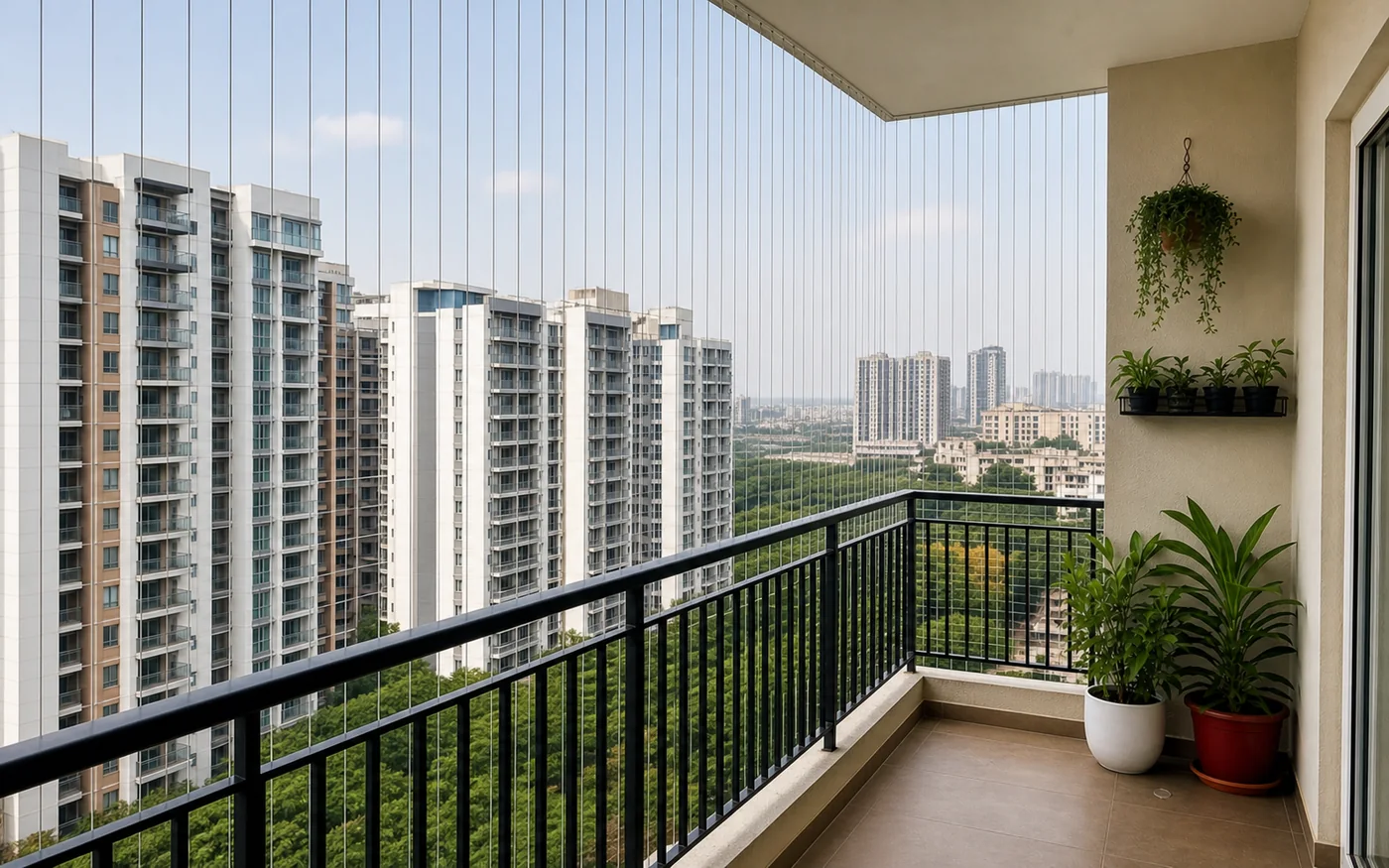
“Which is better: a balcony net or an invisible grill?” is a common starting question, but it leaves out the information that determines a useful answer.
Better for what purpose, across which opening, and for whose use? For a Bangalore home, the choice should follow the problem being addressed. A household trying to exclude pigeons is asking a different question from a household concerned about a child, a pet or access beside an open window.
Begin with the purpose, then compare proposals that address it.
Separate the concerns before comparing products
Write each concern on its own line. You might have bird entry near an AC recess, a cat that explores the balcony, and a preference for a less obstructed view.
Do not combine those into one broad request for “maximum safety.” Ask which parts of the proposal address each concern and what limitations remain.
Ordinary bird netting is not fall protection. Similarly, do not assume that the visible spacing of an invisible grill makes it a bird-exclusion system. Ask about the proposed product's intended application rather than treating all netting or all cables as interchangeable.
Compare the complete installation
A mesh panel and a cable sample tell only part of the story. The opening, support surfaces, perimeter treatment and fitting arrangements are also part of the proposal.
Ask each installer to describe the area being covered, the product supplied and how the full arrangement suits the intended use. If safety performance is claimed, request relevant documentation and an explanation of how it applies to the proposed installation.
Avoid deciding on an advertised load figure without understanding its context. A statement about one material or component does not automatically describe the fitted system at your home.
Give ordinary use a place in the decision
Both options deserve practical questions about doors, windows, laundry equipment, plants and cleaning. Identify the activities that need to continue after fitting.
For instance, in a hypothetical utility balcony, access to an outdoor unit may matter more than achieving a perfectly uninterrupted visual line. The question becomes how maintenance will be carried out, not simply which sample looks lighter.
Discuss any necessary emergency-access or escape arrangements with the appropriate building contact and a qualified professional. Include those requirements before settling on a layout.
Compare appearance after suitability
Once the purpose and installation requirements are clear, look at suitable options from the viewpoints you actually use: the doorway, a chair or the room behind the balcony.
“Invisible” and “transparent” describe appearance, not the absence of physical material. Cables, mesh, borders and fittings will still be present. Ask to see representative samples and understand where the perimeter hardware would sit.
A photograph from another home can communicate a preference, but it should not be treated as a design for your own opening.
Make the decision easy to explain
Before booking, you should be able to say: “We selected this arrangement to address these needs, across these areas, with these access and care arrangements.”
If the explanation is still only “this one looks stronger” or “this one is popular,” return to the unanswered questions. A useful comparison is based on suitability, evidence and the household's routine.
Eversafe's pages for balcony safety nets in Bangalore and invisible grills in Bangalore provide starting points for discussing both options. Share the same brief when requesting proposals so that you can compare answers to the same problem.
Further reading: Bangalore apartment safety guide.
Prepared with AI assistance for Eversafe Safety Nets.


Comments
Post a Comment